The evolution of leak testing methods
From water immersion to industrial air/air solutions
Leak testing is a critical requirement across many industries, including automotive, medical devices, electronics, energy, and packaging. Ensuring that a product is leak-tight is not only about detecting leaks: it is about guaranteeing safety, reliability, performance, and long-term durability.
Over the years, leak testing technologies have evolved significantly to meet increasing demands for quality, production speed, and traceability. This article provides an overview of the historical evolution of leak testing methods, from the earliest techniques to today’s industrial air/air solutions.
1. The origins: water immersion (bubble test)
Historically, the most common method used to check product tightness was water immersion testing.
Principle
The part is pressurized (usually with air) and submerged in water. The appearance of bubbles indicates a leak.
Advantages
- Simple and intuitive method
- Low equipment cost
- Easy to implement
Limitations
- Often destructive or degrading (water enters the product)
- Operator-dependent and subjective
- No quantitative measurement of the leak rate
- Long cycle times
- Not suitable for modern products such as electronics, batteries, or medical devices
While still useful for basic checks or training purposes, immersion testing no longer meets modern industrial requirements.
2. The quest for accuracy: helium testing and mass spectrometry
As performance and safety requirements increased—particularly in aerospace, nuclear, and high-end medical applications—much more sensitive leak detection methods were developed.
Principle
Helium is used as a tracer gas and detected using a mass spectrometer, allowing extremely small leaks to be measured.
Key benefits
- Very high sensitivity
- Accurate and quantitative measurement
- Reference technology for ultra-high-integrity applications
Limitations
- High investment and operating costs
- Complex test processes
- Long cycle times
- Helium handling and supply constraints
- Poor suitability for high-volume production
Helium testing remains an excellent laboratory and validation tool, but its industrial scalability is limited.
3. Industrialization of leak testing: from air/water to air/air methods
To meet production constraints such as speed, repeatability, and cost control, manufacturers progressively moved toward air-based testing solutions.
From air/water to dry testing
Early systems combined air pressurization with wet environments. Over time, water was completely eliminated from the process.
The air/air leak testing principle
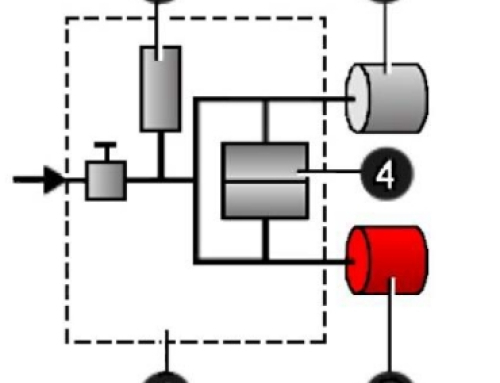
The product is pressurized with air, and leaks are detected by:
- pressure decay measurement,
- flow measurement,
- or comparison with a reference part.
No liquids or tracer gases are required.
Key advantages
- Non-destructive testing
- Short cycle times compatible with production lines
- Quantitative, repeatable results
- Easy automation and integration
- Clean process with no contamination
- Optimized operating costs
This technological shift marked a major turning point: leak testing became a true industrial quality control process.
4. Modern air/air solutions: an industrial standard
Today, air/air leak testing technologies have reached a high level of maturity. They are capable of addressing a wide range of applications, from large volumes to micro-volumes, and from gross leaks to very small leak rates.
Modern systems offer:
- high measurement accuracy,
- optimized cycle times,
- full data traceability,
- seamless integration into automated and connected production environments (Industry 4.0).
These solutions are now essential in key industries such as:
- automotive and e-mobility,
- medical devices,
- electronics,
- energy and hydrogen,
- packaging.
- Defense
5. From leak detection to performance assurance
The evolution of leak testing methods reflects the broader transformation of industrial manufacturing:
- from visible to measurable,
- from destructive to non-destructive,
- from manual inspection to controlled industrial processes.
Today, leak testing is no longer just about finding leaks. It is a strategic element of product quality, user safety, regulatory compliance, and brand protection.
Modern air/air leak testing solutions offer the optimal balance between precision, reliability, and industrial performance—making them the preferred choice for high-volume and high-value manufacturing.
Why choose air/air leak testing?
Air/air leak testing has become the industrial standard for manufacturers seeking efficient, reliable, and scalable quality control solutions.
Key benefits include:
- Non-destructive leak detection suitable for finished products
- Fast cycle times for inline and automated production
- Accurate and repeatable leak rate measurement
- Clean, dry testing with no contamination risk
- Lower operating costs compared to tracer gas methods
- Easy integration into Industry 4.0 environments
Air/air technology is widely used across automotive, medical, electronics, energy, hydrogen, and packaging industries.
ATEQ expertise in industrial leak testing
As a global leader in leak testing solutions, ATEQ supports manufacturers worldwide with advanced air/air technologies designed for production environments.
ATEQ systems combine:
- Proven measurement technologies (pressure decay, flow, differential methods)
- High accuracy and robustness
- Short cycle times optimized for mass production
- Full traceability and data connectivity
- Tailored solutions for each application
Our expertise helps manufacturers move from simple leak detection to complete performance assurance.
Discover our leak testers, including the F600,F28+, and F670LV.
Contact us
Looking to improve your leak testing process or transition to air/air technology?
Our experts are ready to help you define the most reliable and cost-effective solution for your application.
Contact ATEQ to discuss your leak testing requirements and optimize your production quality.